Kenya Insurance Loss Map
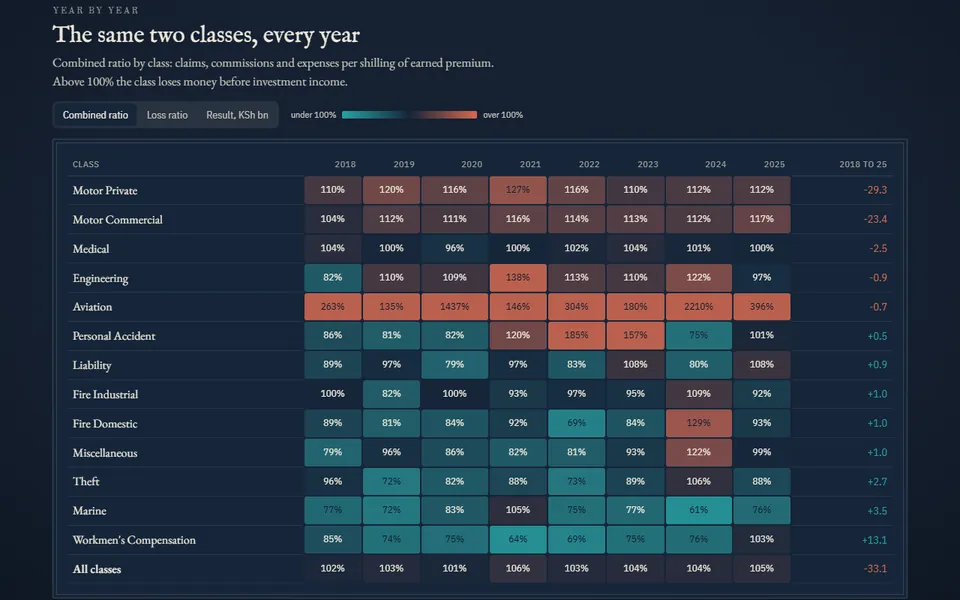
Motor lost KSh 52.6bn on underwriting from 2018 to 2025, in every one of the eight years. On 2023 to 2025 experience, motor commercial premiums would need to rise 15.6% to break even.
From 2022 to 2025 I worked in data, actuarial and reserving roles at an insurance group in Kenya and Mauritius. The work below rebuilds Kenya's general insurance market from the regulator's own returns, checks it 42,246 times, and answers the questions an insurer's board or a reinsurer would ask of it.
Third place, Kenya Re 3rd AI4 Hackathon 2026Fourth place, Kenya Re AI4 Hackathon 2025
Ten years of US industry paid claims for one line. The page fits a chain ladder on the known cells and fills the empty corner one calendar year at a time.
| Accident year | 1 | 2 | 3 | 4 | 5 | 6 | 7 | 8 | 9 | 10 |
|---|---|---|---|---|---|---|---|---|---|---|
| 1988 | ||||||||||
| 1989 | ||||||||||
| 1990 | ||||||||||
| 1991 | ||||||||||
| 1992 | ||||||||||
| 1993 | ||||||||||
| 1994 | ||||||||||
| 1995 | ||||||||||
| 1996 | ||||||||||
| 1997 |
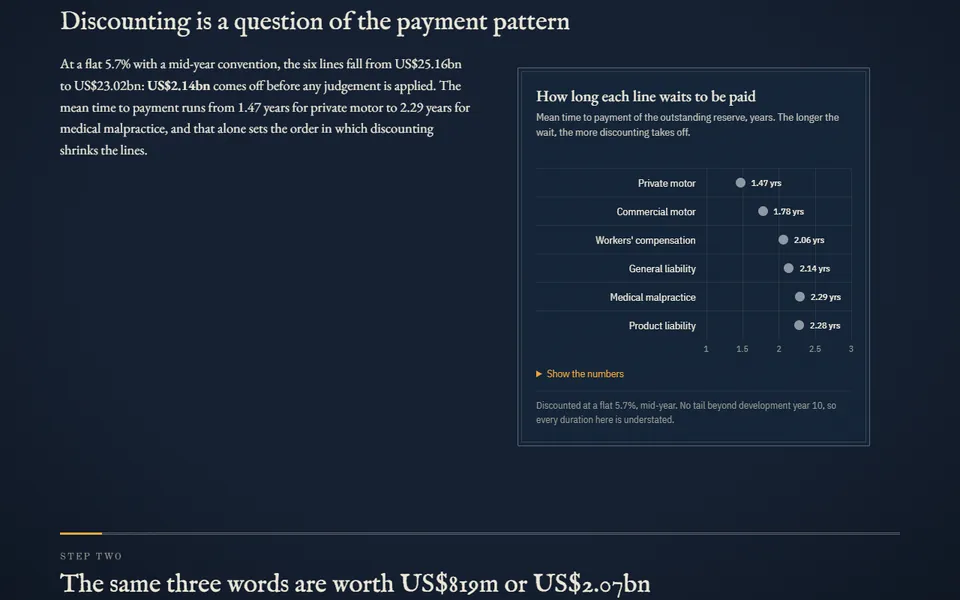
NAIC Schedule P, all US insurers, accident years 1988 to 1997. The six lines need US$25.2bn, the reserve the IFRS 17 case study starts from.
Start from the source and check it before believing it. Kenya's insurance market rebuilt from the regulator's own returns, M-Pesa statements read and reconciled, a cargo terminal simulated and staffed, a cargo airline's risk layer, a dealer group's ledgers taken apart and two forecasting products.
Kenya seriesReinsurer signalsClaims settlementAsk the dataM-Pesa seriesAviation and marineAudit and models
Every general insurer and reinsurer in Kenya, every quarter from Q4 2016 to Q1 2026, extracted from the Insurance Regulatory Authority's statistics and checked against itself. Five pages, one validated dataset, three public repositories.
Motor lost money in every one of the eight years from 2018 to 2025. Every other class together made KSh 19.6bn.
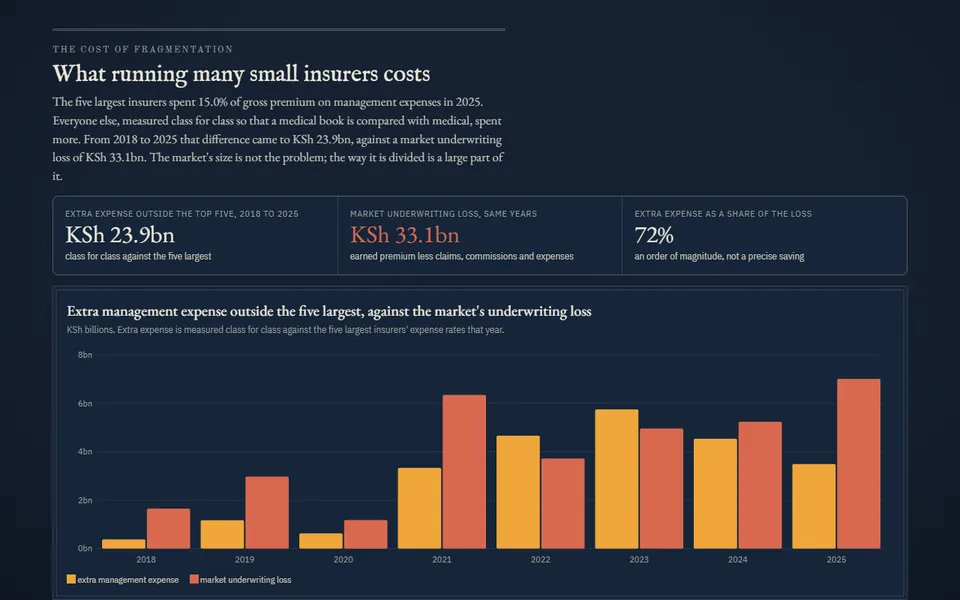
How the series is builtKSh billions, every general insurer in Kenya. Market total KSh -33.1bn. Motor lost money in all 8 years.
Motor lost KSh 52.6bn on underwriting from 2018 to 2025, in every one of the eight years. On 2023 to 2025 experience, motor commercial premiums would need to rise 15.6% to break even.
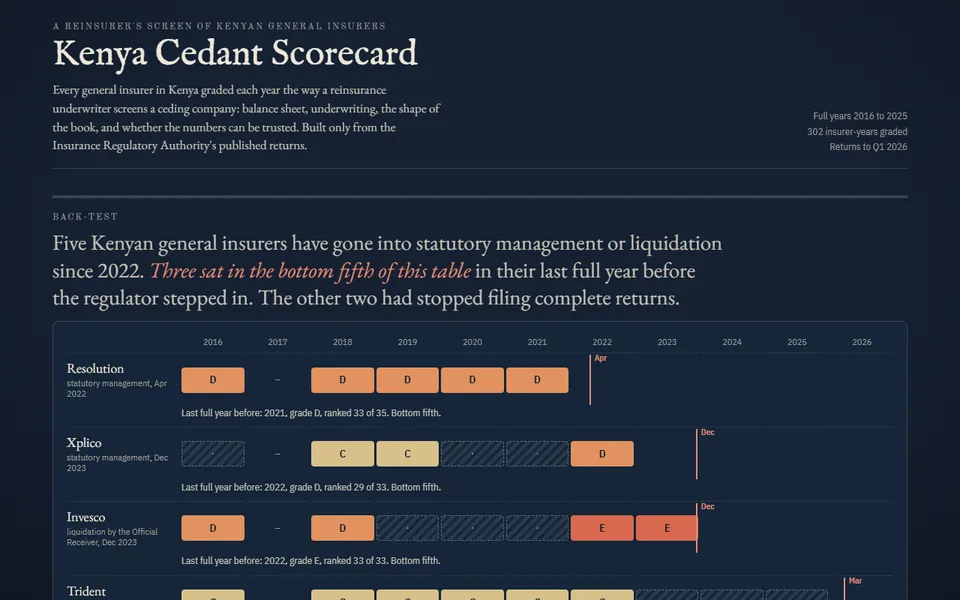
Every insurer graded A to E each year the way a reinsurer screens a cedant. 3 of the 5 insurers placed under statutory management or liquidation since 2022 were in the bottom fifth a year before the regulator acted.
In 2020, two insurers wrote over KSh 10bn a year and held 16% of the market. By 2025, seven did, holding 53%. The ten insurers losing share ran a median combined ratio of 112.0%.
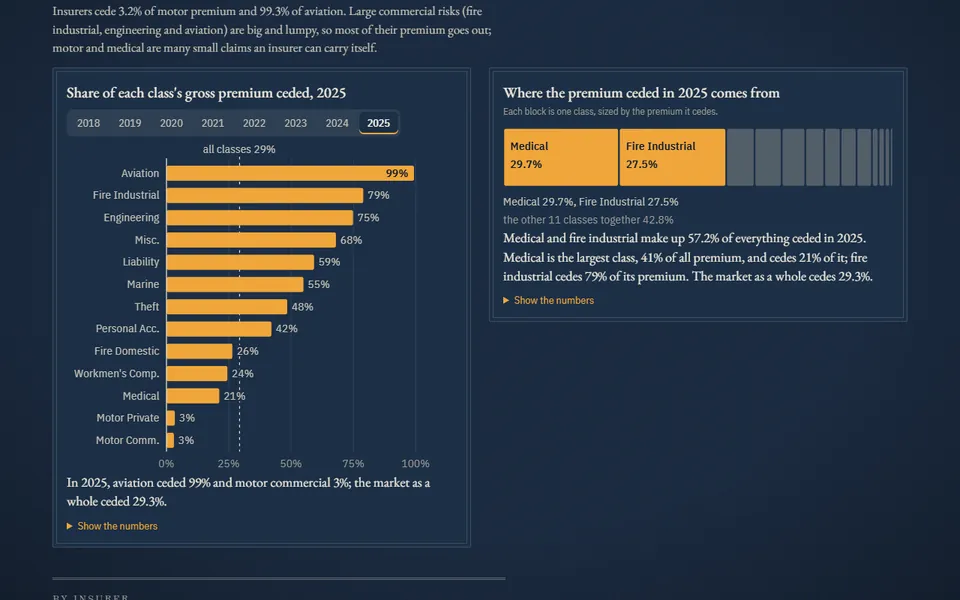
Kenyan general insurers passed KSh 66.6bn of premium to reinsurers in 2025, 29.3% of what they wrote: 3.2% of motor, 99.3% of aviation. At most 49% of it could have gone to the five reinsurers that file IRA returns. The local reinsurers' net commission rose from 23.2% of earned premium in 2018 to 32.0% in 2025.
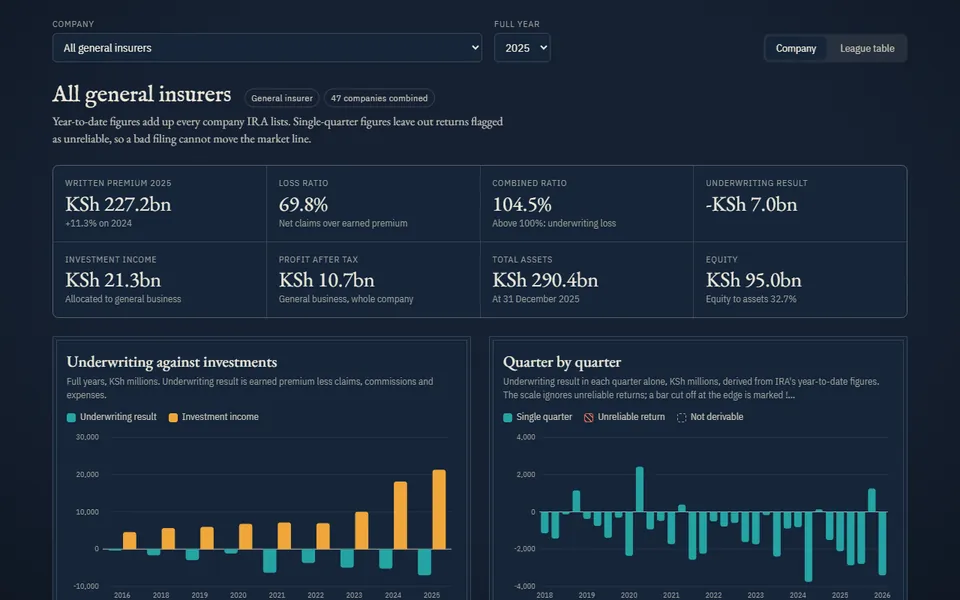
Any insurer, any year: premium, ratios, single quarters, class mix, balance sheet and every return-quality flag, including the 12 returns that add up on their own but cannot be right.
Three results from the series that change a decision. Insurer names stay inside the analysis pages, next to the method and caveats.
3 of 5
insurers the regulator stepped into since 2022 sat in the bottom fifth of the table a year before it acted.
Five cases is a small sample, and the test cannot show how many low-graded insurers carried on without trouble.
8 of 10
insurers that booked a motor loss ratio under 40% in some year had negative equity, a capital shortfall or regulator action at some point since 2018, against 7 of the other 28 motor insurers.
Fisher's exact test, p = 0.006. A low loss ratio is often a reserving question, not a pricing success.
9 of 34
insurers made an underwriting profit in 2025, down from 19 of 35 in 2016.
In 2025 the market's KSh 7.0bn underwriting loss was covered by KSh 21.3bn of investment income.
The Kenya series asks where insurers make and lose money. This analysis asks whether they pay claims, and how fast: general and life business, every insurer, every quarter IRA has published since 2017, checked 12,791 times.
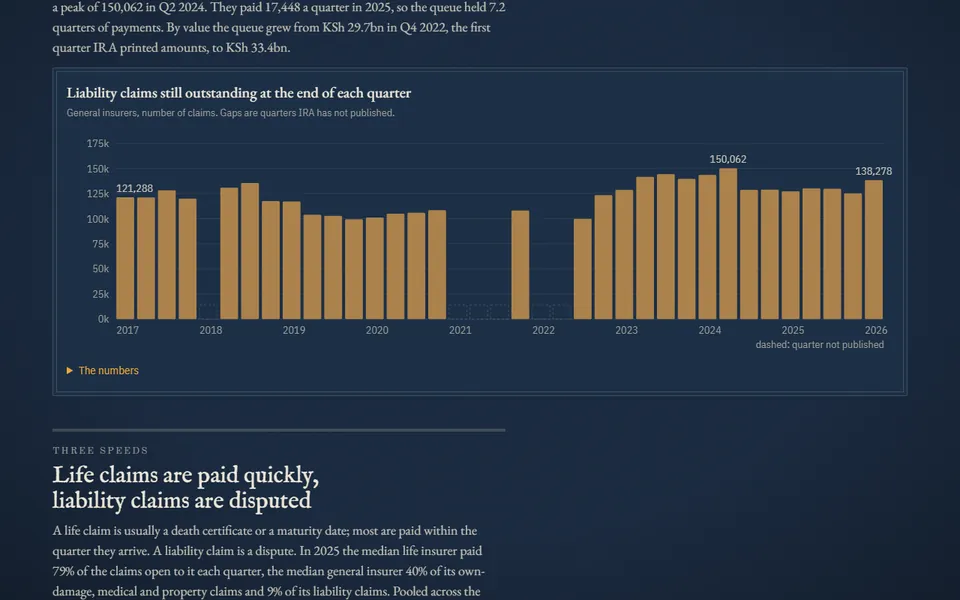
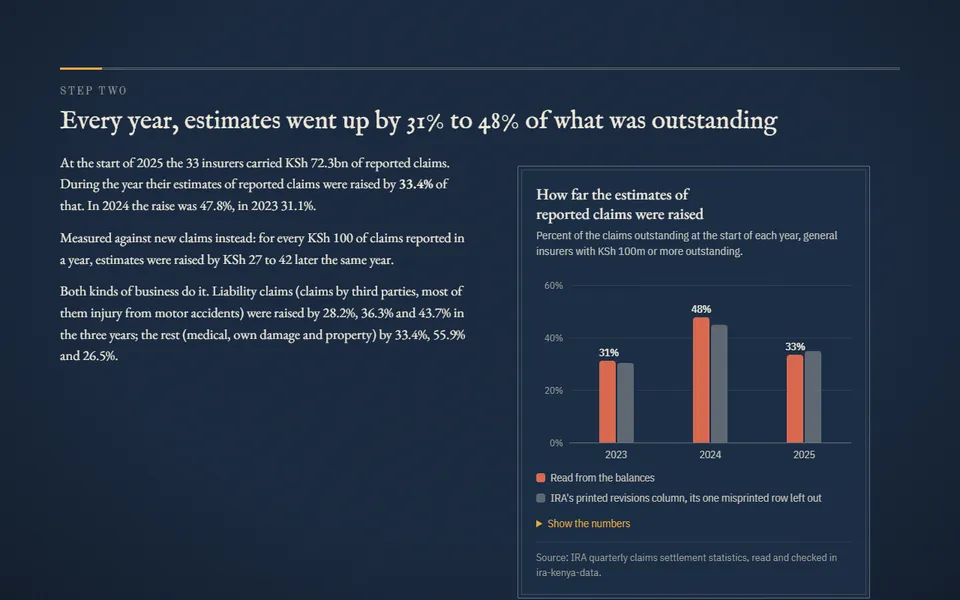
In an average quarter of 2025 general insurers paid 11.7% of the liability claims open to them, up from 8.2% in 2017; life insurers paid 78.7% of theirs. 125,141 liability claims, KSh 33.4bn by the insurers' own estimates, were still outstanding at the end of 2025: 7.2 quarters of payments.
3 of 5
insurers the regulator stepped into since 2022 had, at some point since 2017, paid liability claims at under half the median insurer's rate for four quarters running. So had 9 of the other 34 general insurers.
Paying slowly is common and is not on its own a sign of trouble: nine of the twelve insurers with four slow quarters in a row carried on writing business. Five cases is a small sample.
The market, any insurer, the scorecard or reserving, answered in your browser from the validated figures. No language model, so nothing is made up.
M-Pesa statements hold the money records of many Kenyan households and small businesses, and they arrive as PDFs. This series turns them into data that can be checked, starting with the statement itself.
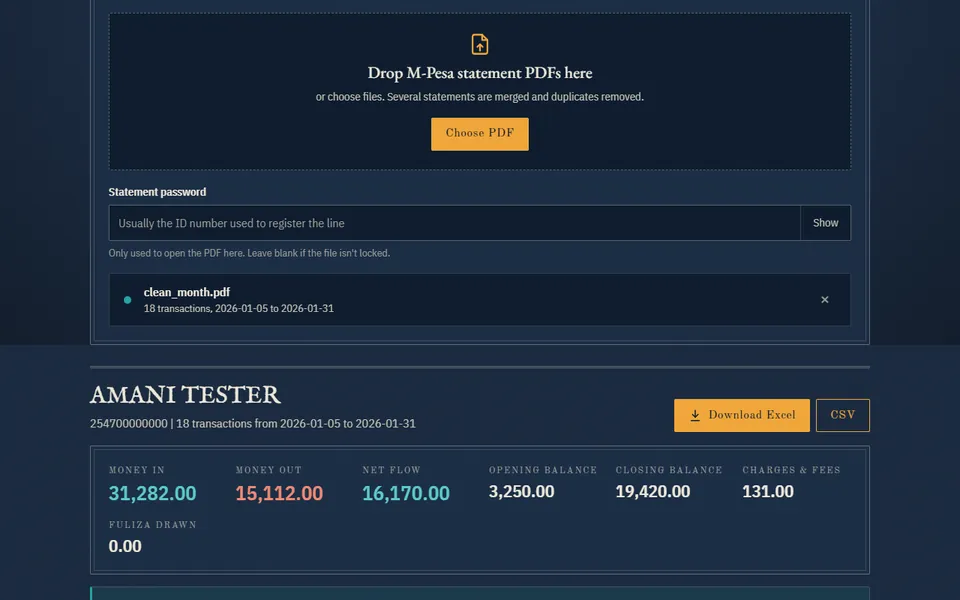
Reads Safaricom M-Pesa PDF statements into a formatted Excel workbook inside your browser: nothing is uploaded, and every balance is reconciled to the one before it. Ask it about your statement, or look up any transaction by a name, a phone or till number, a receipt code, an amount or a date.
Running balance. Every row's balance must equal the previous balance plus money in minus money out. Rows that do not follow are flagged, with the balance they should have had.
The statement's own totals. Money in and money out are compared with the TOTAL line of the statement's summary table.
Nothing leaves the browser. A content security policy blocks every other server, and the tests record every request the page makes and fail if one leaves it.
A layout change needs a parser update. The parser reads where each value sits on Safaricom's statement. If that layout changes, the balance check shows the misread instead of hiding it.
An import terminal's floor, simulated and staffed so freight is ready on time, and a cargo airline's risk and cover layer that screens each booking before it is accepted. Both run on synthetic data, so every number can be published.
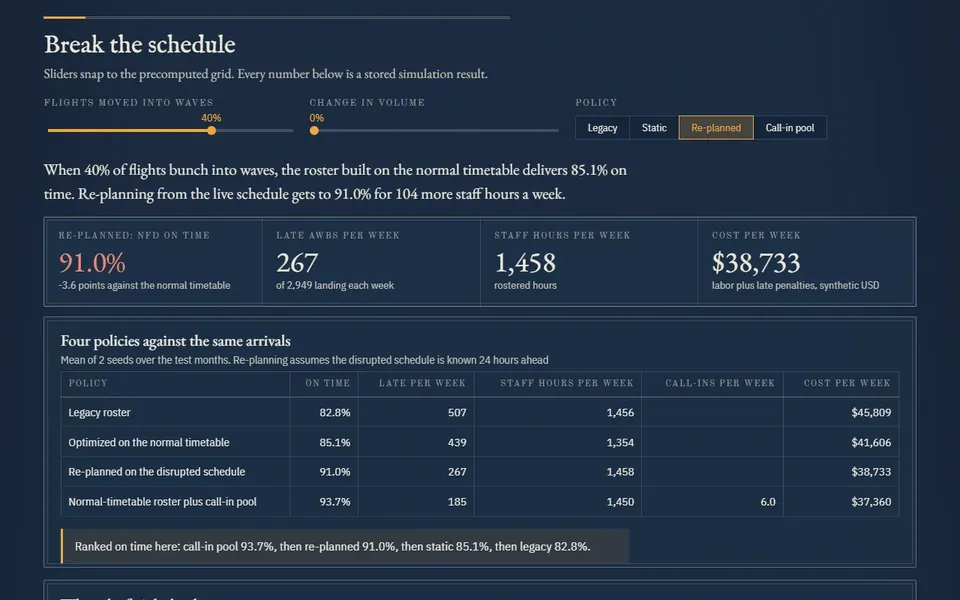
A simulated import terminal at a Gulf hub: 230,796 air waybills over 18 months. The optimized roster delivers 94.6% on time against 91.9% for the legacy roster, on 1,354 staff hours a week instead of 1,456. When 40% of flights bunch into waves, it falls to 85.1%, and a call-in pool of 4 staff gets it back to 93.7%.
The app may take a few seconds to load while it starts up.
A trust and risk layer for a cargo airline: anyone can check an air waybill or a cover certificate in seconds, every booking is scored from 0 to 100 with plain-English reasons before it is accepted, and lower-risk bookings get a cargo insurance quote priced from the same score.
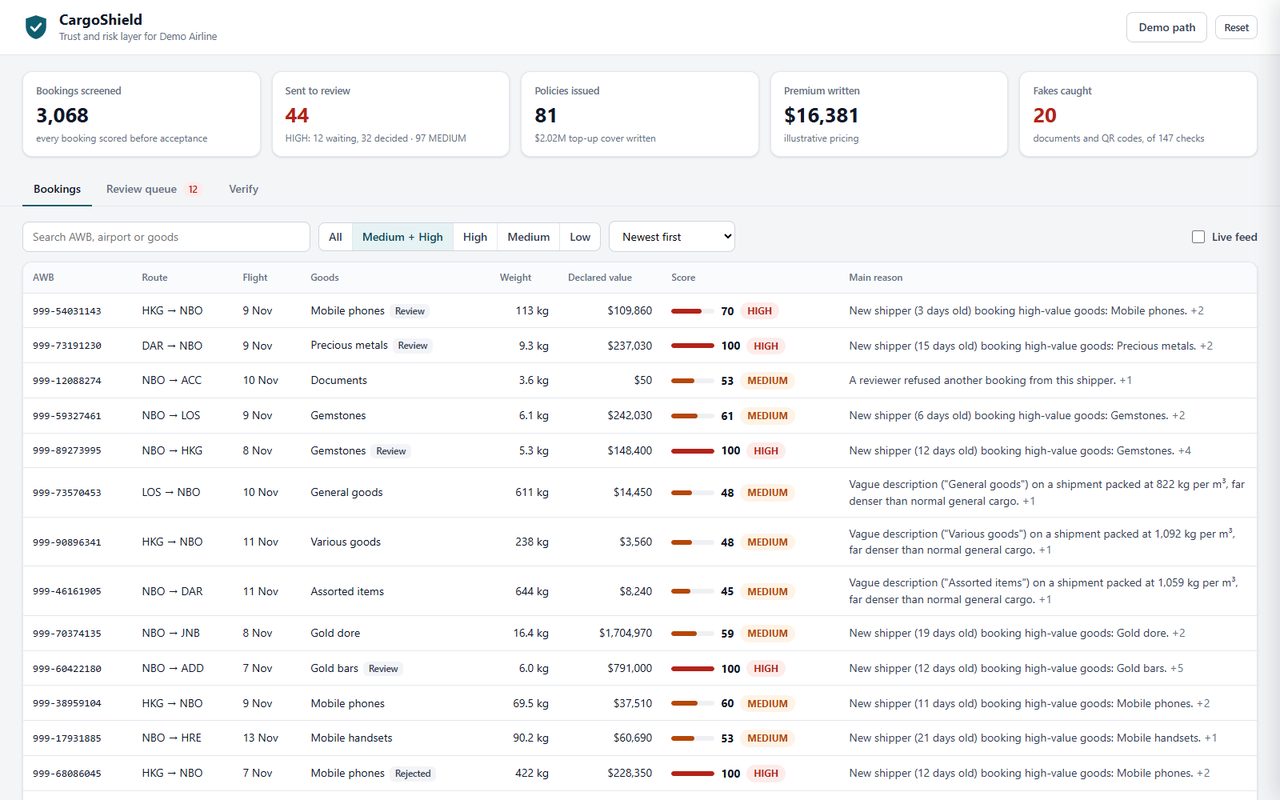
A trust and risk layer for a cargo airline: anyone can check an air waybill or a cover certificate in seconds, every booking is scored from 0 to 100 with plain-English reasons before it is accepted, and lower-risk bookings get a cargo insurance quote priced from the same score. Shown on a fictional airline with synthetic data; a high score sends the booking to a person, and nothing is rejected automatically.
No public link yet. Ask me for a walk-through: get in touch.
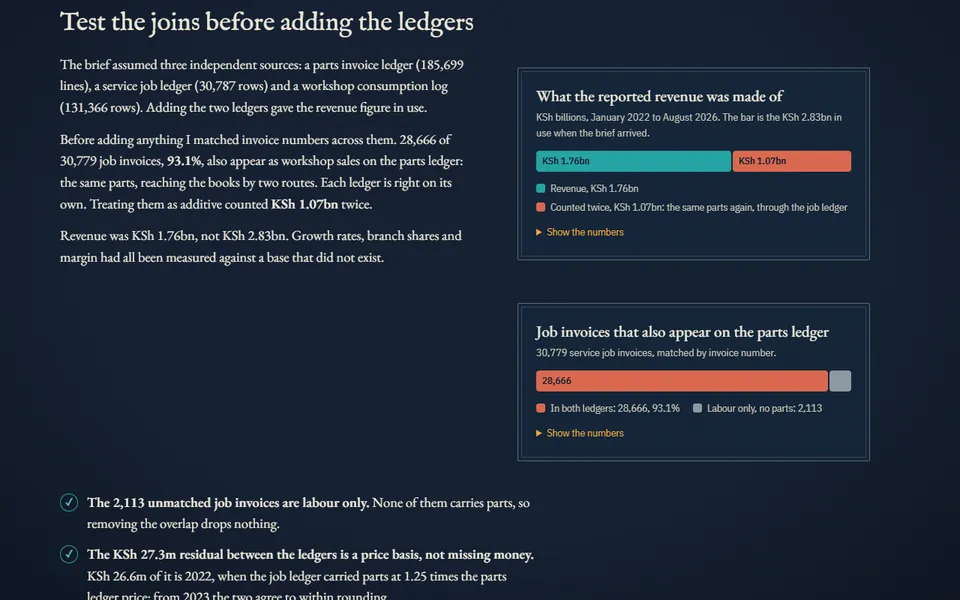
Automotive: a Kenyan client's ledgers, published without client identifiers. And two products that turn data into a forecast someone can act on.
Forecasts severe pastoral drought one to three months ahead for Kenya's northern pastoral counties, and turns the forecast into a household decision in shillings and an SMS in Kiswahili.
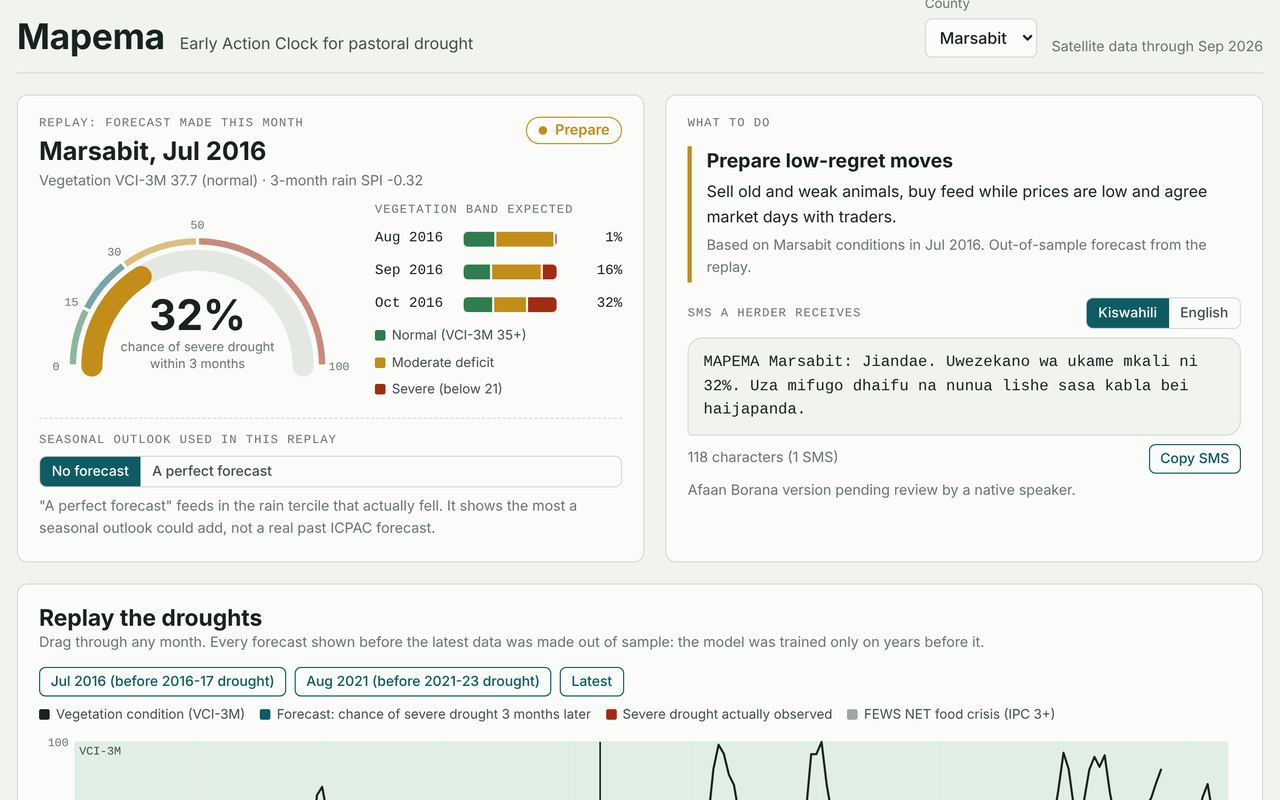
Forecasts severe pastoral drought one to three months ahead for Kenya's northern pastoral counties, and turns the forecast into a household decision in shillings and an SMS in Kiswahili.
No public link yet. Ask me for a walk-through: get in touch.
A Dixon-Coles football model and the pipeline that turns real match data into pre-match probabilities, a most likely scoreline and an accuracy scorecard after the game.
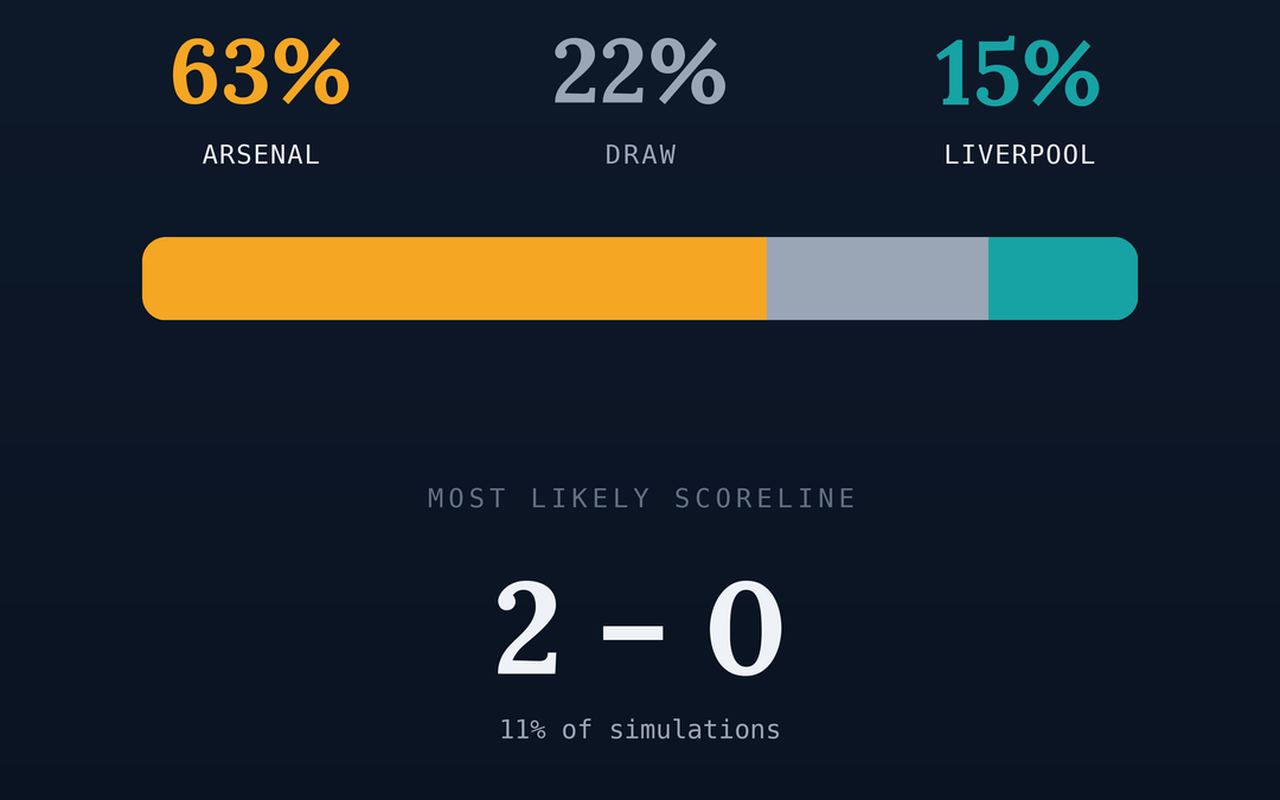
A Dixon-Coles football model and the pipeline that turns real match data into pre-match probabilities, a most likely scoreline and an accuracy scorecard after the game.
No public link yet. Ask me for a walk-through: get in touch.
Reserves, persistency and pricing, each built on a synthetic book, public industry triangles or the tables insurers publish, so every number can be published, then tested until it breaks.
A synthetic health book, the tables Kenya's listed insurers publish, the regulator's claims statistics for every Kenyan general insurer, and the long US industry triangles IFRS 17 measurement needs.
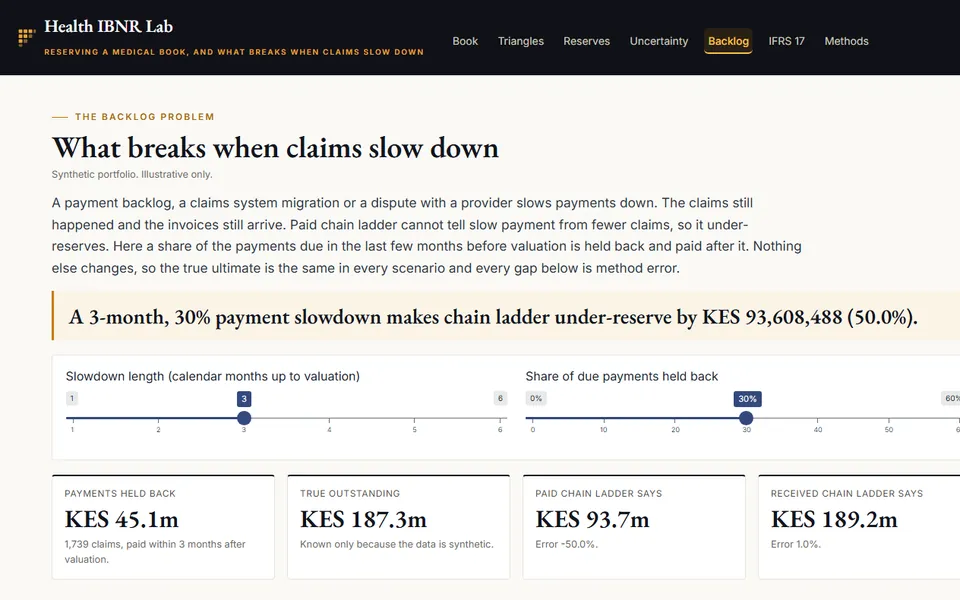
A synthetic medical book of 64,646 claims. Best estimate outstanding KES 138,821,204, Mack CV 12.0%. Then the test that matters: a 3-month, 30% payment slowdown makes chain ladder under-reserve by 50.0%.
The app may take a few seconds to load while it starts up.
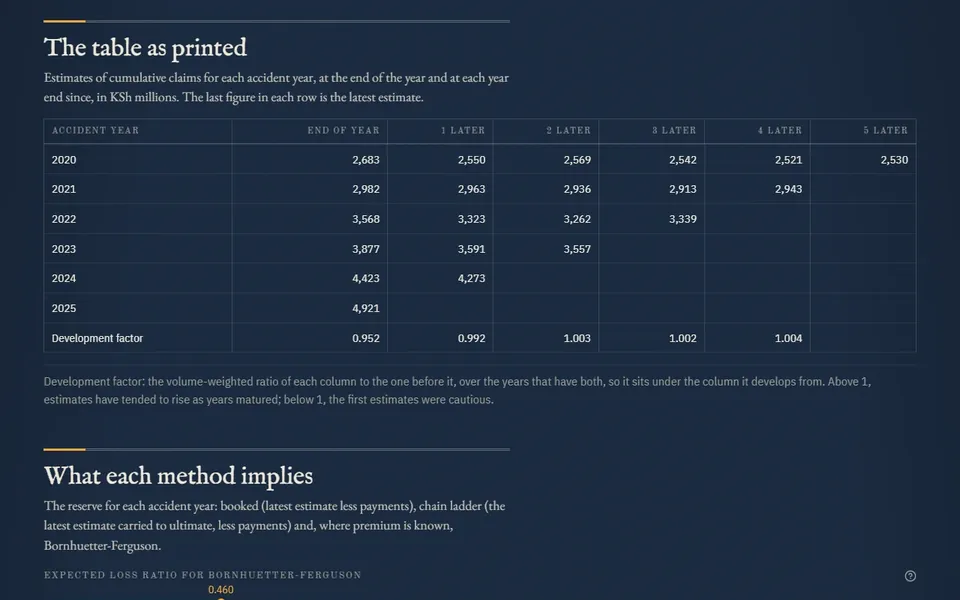
Chain ladder and Bornhuetter-Ferguson on the claims development tables Kenya's listed insurers publish under IFRS 17, set against the reserves they booked. The first finding is about the tables: of the six insurance groups listed on the Nairobi Securities Exchange, two print one that holds together and ties to the liability in their own notes.
The app may take a few seconds to load while it starts up.
Built on synthetic books so every number can be published, with the assumptions on the page and tests behind them.
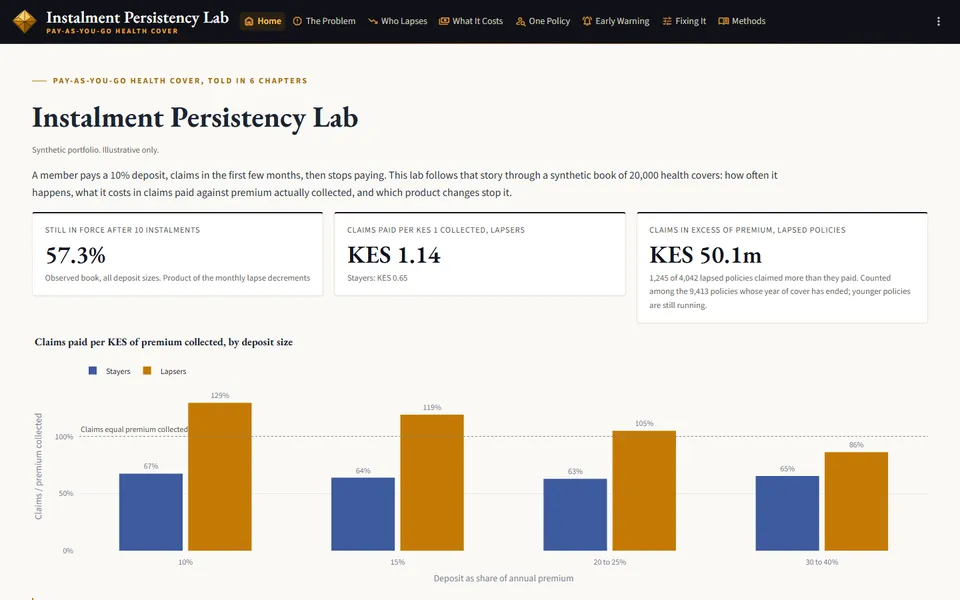
Pay-as-you-go health cover on a synthetic book of 20,000 policies. 57.3% are still in force after the 10th instalment, and members who lapse are paid KES 1.14 in claims for every KES 1 they paid in, against KES 0.65 for members who stay.
The app may take a few seconds to load while it starts up.
Parametric maize insurance for Kenyan smallholders, sold through SACCOs: a rainfall index triggers payouts and every pricing run can be reproduced.
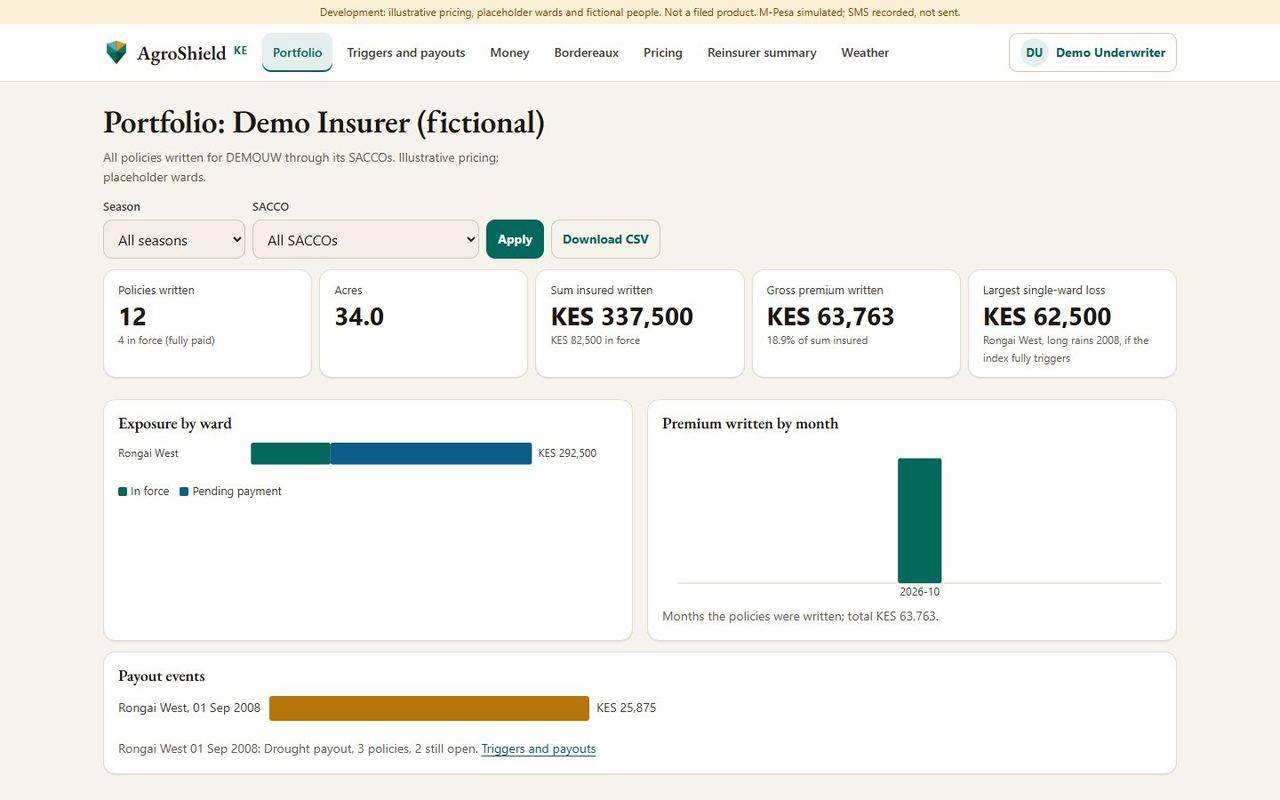
Parametric maize insurance for Kenyan smallholders, sold through SACCOs: a rainfall index triggers payouts and every pricing run can be reproduced. Shown on a fictional insurer with illustrative pricing; M-Pesa payment is simulated in the demo.
No public link yet. Ask me for a walk-through: get in touch.
The habit from actuarial training that stuck: distrust a clean number until it survives being split apart.
If you are hiring for an actuarial, pricing, reserving or data role at an insurer or reinsurer, write to me.